Post Impressionism
Post Impressionism was the name given to several styles of painting at the end of the 19th century which influenced the direction of art in the early decades of the 20th century.
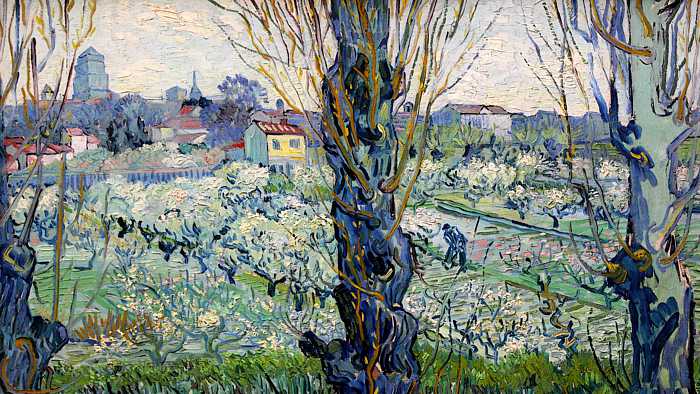
VINCENT VAN GOGH (1853-1890)
'View of Arles-Orchard in Bloom with Poplars', 1890 (oil on canvas)
Post Impressionism was not a formal movement or style. The Post Impressionists were a few independent artists at the end of the 19th century who rebelled against the limitations of Impressionism. They developed a range of personal styles that focused on the emotional, structural, symbolic and spiritual elements that they felt were missing from Impressionism. Their combined contributions form the artistic roots of modern art for the next eighty years.
Impressionism was the first movement in the canon of modern art. Like most revolutionary styles it was gradually absorbed into the mainstream and its limitations became frustrating to the succeeding generation. Artists such as Vincent Van Gogh, Paul Cézanne, Paul Gauguin and Georges Seurat, although steeped in the traditions of Impressionism, pushed the boundaries of the style in different creative directions and in doing so laid the foundations for the art of the 20th century. Their name was derived from the title of the exhibition 'Manet and the Post-Impressionists' which was organized in London by the English artist and critic Roger Fry in the winter of 1910-11. For historical convenience these artists have been labeled as Post Impressionists but, apart from their Impressionist influence, they don't have that much in common.
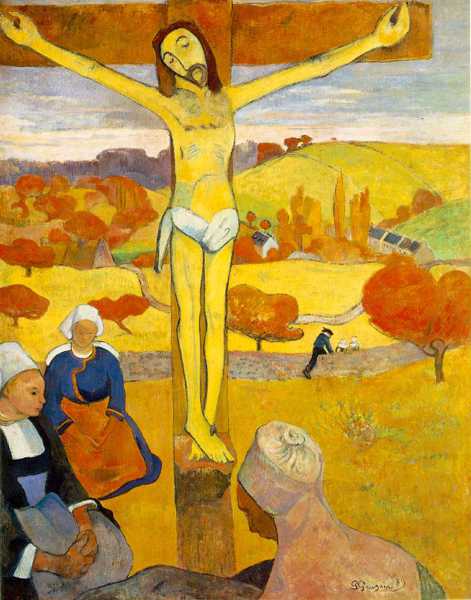
PAUL GAUGUIN (1848-1903)
'The Yellow Christ', 1889 (oil on canvas)
Cloisonnism, Synthetism and Symbolism were some of the terms associated with the Post Impressionist paintings of Paul Gauguin in order to distinguish them from Impressionism.
The term Cloisonnism was coined by the critic Edouard Dujardin and refers to the jewellery technique of inlaying metal surfaces with 'cloisonné' enamel colors (the word 'cloison' in French means a 'border'). The decorative effect of this process resembled the bold outlines and flat color of Gauguin's art.
In Synthetism, the artist's aim was to 'synthetize' his feelings with the elements of his painting by simplifying its shapes and amplifying its color to increase its emotional and expressive power. The result was seen as a symbol of the artist's thoughts and feelings and consequently Gauguin's style of painting was also referred to as 'Symbolism'.
'The Yellow Christ' is a classic example of his style. It depicts some traditional Breton women praying at a roadside grotto but it is not a documentary illustration of the scene; it is an attempt to portray the spiritual vision that they experience in their prayer. In this painting Gauguin was inspired by the naive simplicity of a wooden 17th century crucifix that he saw in the nearby church at Tremalo and he uses its primitive form and autumnal yellow color as a key to the work. He then simplifies his drawing, boldly outlines his shapes and exaggerates his color to magnify the heightened emotion of the women's prayerful meditation.
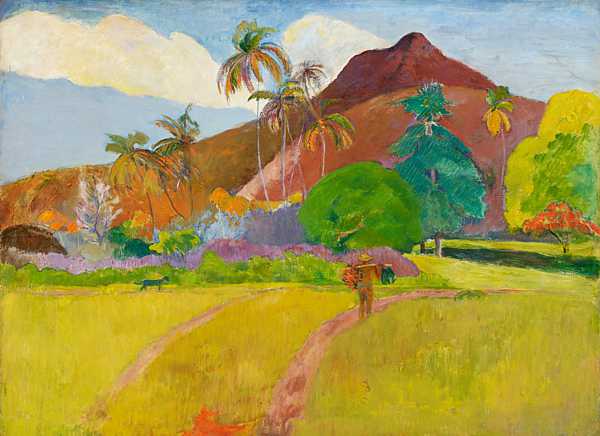
PAUL GAUGUIN (1848-1903)
'Tahitian Landscape', 1893 (oil on canvas)
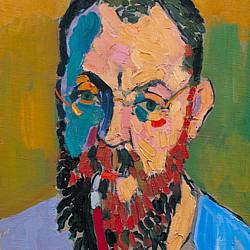
Gauguin's work can be split into two phases: an early period spent painting around the rustic town of Port Aven in Brittany; and a later period (post 1891) in search of the primitive lifestyle in Tahiti and the Marquesas Islands in the South Pacific. He fused his symbolic use of colour with images of both environments to create a highly personal and expressive vision that pushed art towards the exhilarating style of Fauvism.
Vincent Van Gogh (1853-90)
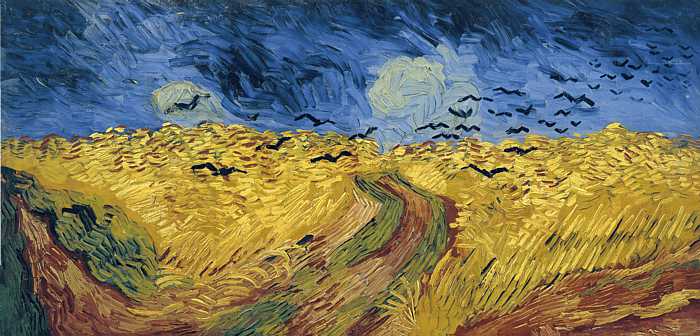
VINCENT VAN GOGH (1853-1890)
'Wheatfield with Crows', 1890 (oil on canvas)
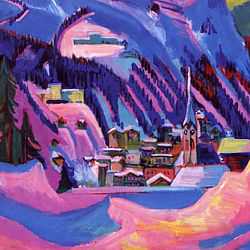
Vincent Van Gogh embraced the vivid color of Impressionism but discarded any Impressionist ideas about the careful analysis and effects of color and light in nature. This was far too scientific an approach for this temperamental Dutchman whose gut instincts were tuned to the expressive power of color. When Impressionism was filtered through the heightened perception of Van Gogh's vision, the results pushed art towards Expressionism, an exploration of the spiritual and emotional side of art.
Paul Cézanne (1839-1906)
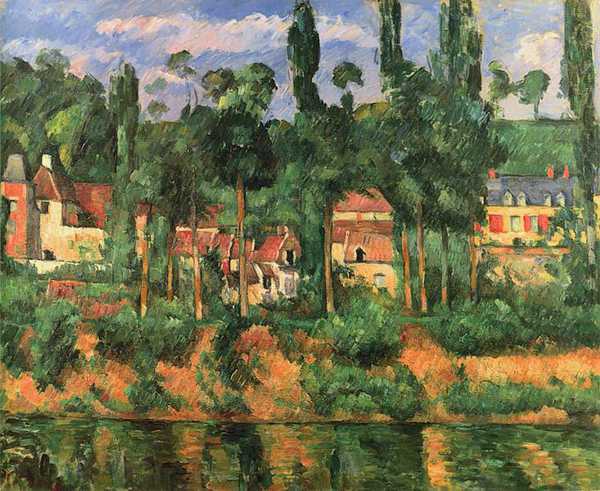
PAUL CÉZANNE (1839-1906)
'The Château at Médan', 1880 (oil on canvas)
Paul Cézanne believed that the Impressionists had lost one of the classical hallmarks of great art: a structured composition where the visual elements are carefully refined and balanced to work in harmony with one another. He felt that the Impressionists' technique was naturally limited, principally because they had to work so quickly to capture the fleeting effects of atmospheric conditions. Paul Cézanne wanted to make paintings whose compositions were more tightly organized and "make of Impressionism something solid and durable, like the art of the museums ".
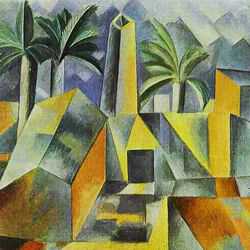
He called his pictures 'constructions after nature' in which elements from the three-dimensional world were translated into patterns of shapes and colors arranged on a flat canvas. The way that Cézanne structured and abstracted his paintings with carefully modulated color pushed art towards the revolutionary style that was Cubism.
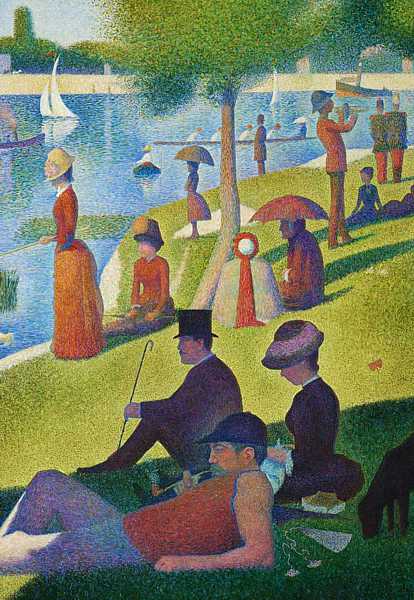
GEORGES SEURAT(1859-1891)
Detail: 'A Sunday Afternoon on the Île de la Grande Jatte', 1884 (oil on canvas)
Georges Seurat's frustration with the limitations of Impressionism, particularly its lack of accurate line and detail, drove him to develop the technique of Pointillism or as it was otherwise called, Neo-Impressionism. This was a more scientific approach to the mixture of color which was applied in small dots of paint that blended optically when viewed from a distance.
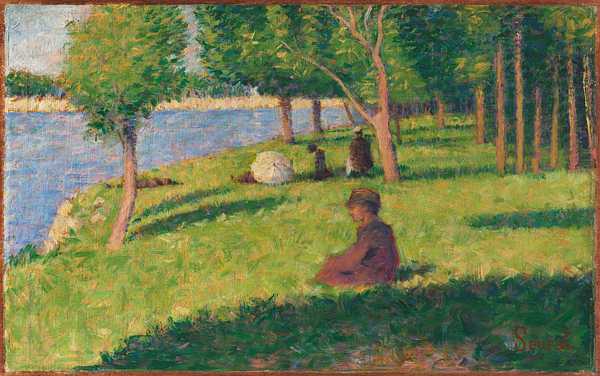
GEORGES SEURAT(1859-1891)
Study: 'A Sunday Afternoon on the Île de la Grande Jatte',1884 (oil on canvas)
You often see works by Seurat that look more like Impressionism than Pointillism. This is because he painted his sketches outside using an Impressionistic technique to quickly capture the fleeting effects of natural light and color.
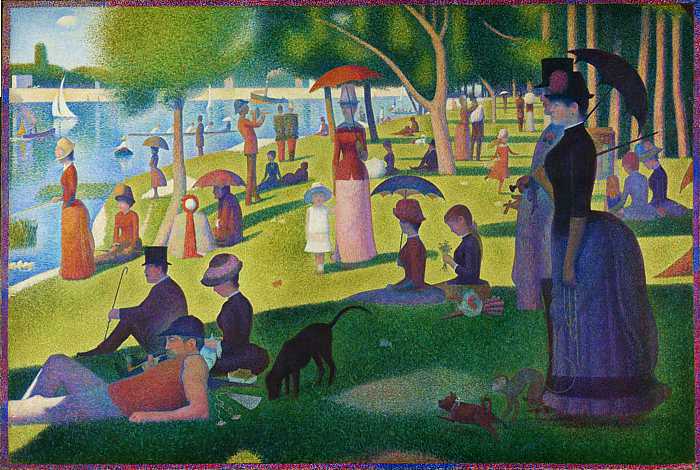
GEORGES SEURAT(1859-1891)
'A Sunday Afternoon on the Île de la Grande Jatte', 1884 (oil on canvas)
He would then take these preparatory sketches back to his studio and rework them using his more methodical Pointillist technique. This allowed him to take a more considered and classical approach to composition, using sharper lines and more clearly defined shapes while still retaining the vitality of Impressionist light and color.
Post Impressionism Notes
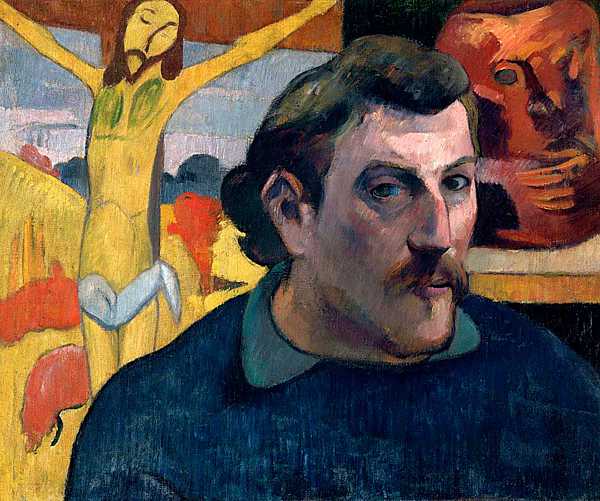
PAUL GAUGUIN (1848-1903)
'Portrait of the Artist with the Yellow Christ', 1889 (oil on canvas)
The Post Impressionists were a few independent artists at the end of the 19th century who rebelled against the limitations of Impressionism to develop a range of personal styles that influenced the development of art in the 20th century.
-
The art of Paul Gauguin was a major influence in the development of Fauvism.
-
The art of Vincent Van Gogh was an influence on Expressionism in the 20th century.
-
The art of Paul Cézanne was an influence on Cubism at the start of the 20th century.
-
The analytical method of Seurat's Pointillism influenced those artists who adopted more calculated approach to painting, particularly in the development of abstract art.