Painting a Tree in Spring
In this lesson we explore the process of painting a tree with the budding leaves and emerging colors of springtime.

- How to Paint a Tree in Spring
- spring-tree-10
Painting a Tree in Spring
- spring-tree-1
Paint the sky first
- spring-tree-2
Add a rainbow for atmospheric effect
- spring-tree-3
Add some low-level rain clouds
- spring-tree-4
Paint the foreground next
- spring-tree-5
Add some grassy texture
- spring-tree-6
Vary the tone, texture and color of the grass
- spring-tree-7
Paint the flat shape of the tree
- spring-tree-8
Add some light, shade and texture to the tree
- spring-tree-9
Build up a light covering of leaves
- spring-tree-10
Tie the tree down with its shadow

Our slide show illustrates a step-by-step technique for painting a tree in the afterglow of a spring shower. The tree is based on the example developed in our lesson on 'Painting a Tree'.
-
When you begin a painting, an organised method of approach is important as it helps you to tackle the work with some degree of control and confidence. Our slide show guides you through such an approach that you may adapt to your own style and technique.
Paint the sky first

If you want to paint a tree in any season, it helps to add some context with a relevant background that identifies the climatic conditions of that time of year. This starts with the sky which establishes the mood of the painting.
-
To begin with we have painted a transitional sky that graduates from a sunlit glow to a foreboding gloom, suggesting the eerie light that follows the passing of a spring downpour.
Add a rainbow for atmospheric effect

Next, we have painted a rainbow; the visual sign that follows a passing downpour.
Add some low-level rain clouds

The addition of some turbulent clouds helps to emphasise the atmospheric power of the receding rainstorm.
Paint the foreground next

To start the foreground, we have used a flat earthy green as the base color of our spring meadow.
Add some grassy texture

Next, we stipple the surface with a brighter green to add a grassy texture.
-
Starting with a lighter concentration of marks in the closest section of the foreground, we gradually merge them together as we approach the horizon to convey a sense of a sense of depth and distance.
Vary the tone and texture of the grass

We now strengthen the visual impact of the meadow with a sweeping shadow on the left that gently fades and transforms into a glowing patch of sunlight on the right.
-
This tonal progression on the grass creates a dramatic contrast to the movement of light and dark in the sky, forming a balanced counterpoint along the horizon.
-
The naturalism of the scene is rounded off with a spattering of red, yellow, and lilac dots to represent a flourishing array of wildflowers.
Paint the flat shape of the tree

Now that the foreground and background are established, it is time to paint our tree.
-
For a detailed account of how we built up the flat image of this tree please look at our page on painting a tree.
Add light,shade, and texture to the tree

The addition of light and shade to the trunk and branches establishes the volume of the tree and sets it firmly in the landscape.
Build up a light covering of leaves

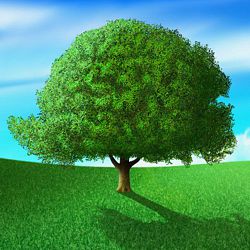
In springtime the foliage of a tree is still developing, and its leaves are smaller and fewer than you would find in its full summer growth. They are also lighter in color due to their immaturity.
-
When you are painting the leaves of a tree in spring, do not overdo their density so that you are still able to see some of the branches through the foliage.
-
You can still add volume to the tree by varying the tone of the leaves in relation to the direction of the light.
Painting a Tree in Spring - Finish by tying the tree down with its shadow
Finally, the addition of a shadow firmly grounds the tree and adds a contrasting element that improves the composition of the work.