Cubism
Cubism was the first abstract art style. Cubist painting abandoned the tradition of perspective drawing and displayed many views of a subject at one time.
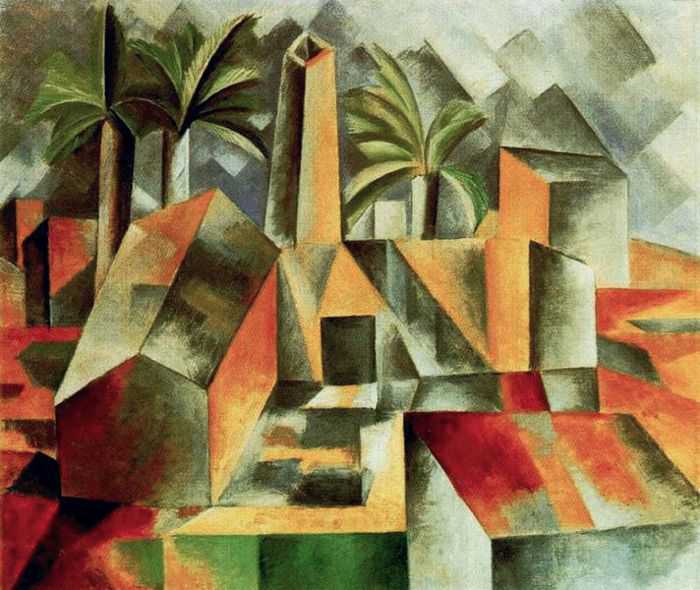
PABLO PICASSO (1881-1973)
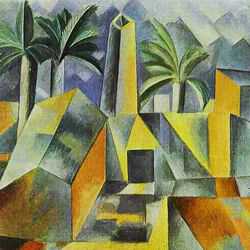
'Factory, Horta de Ebbo', 1909 (oil on canvas)
Cubism was a truly revolutionary style of modern art developed by Pablo Picasso and Georges Braques. It was the first style of abstract art which evolved at the beginning of the 20th century in response to a world that was changing with unprecedented speed. Cubism was an attempt by artists to revitalise the tired traditions of Western art which they believed had run their course. The Cubists challenged conventional forms of representation, such as perspective, which had been the rule since the Italian Renaissance. Their aim was to develop a new way of seeing which reflected the modern age.
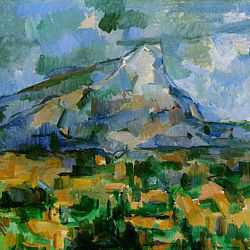
In the four decades from 1870-1910, western society witnessed more technological progress than in the previous four centuries. During this period, inventions such as photography, cinematography, sound recording, the telephone, the automobile and the airplane heralded the dawn of a new age. The problem for artists at this time was how to reflect the modernity of the era using the tired and trusted traditions that had served art for the last four centuries. Photography had begun to replace painting as the tool for documenting the age and for artists to sit illustrating cars, planes and images of the new technologies was not exactly rising to the challenge. Artists needed a more radical approach - a 'new way of seeing' that expanded the possibilities of art in the same way that technology was extending the boundaries of communication and travel. This new way of seeing was called Cubism - the first abstract style of modern art. Picasso and Braque developed their ideas on Cubism around 1907 in Paris and their starting point was a common interest in the later paintings of Paul Cézanne.
The Influence of Cézanne
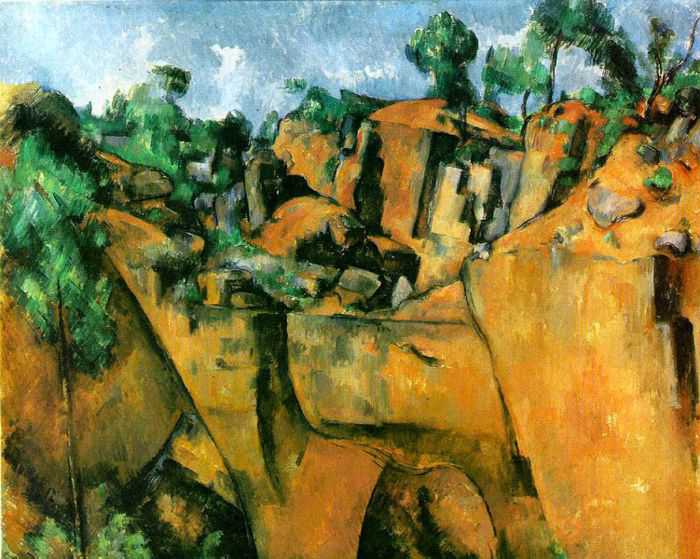
PAUL CÉZANNE (1839-1906)
'Bibemus Quarry', 1895 (oil on canvas)
Paul Cézanne was not primarily interested in creating an illusion of depth in his painting and consequently he abandoned the tradition of perspective drawing. Perspective, which had been used since the Early Renaissance, was a geometric formula that solved the problem of how to draw three-dimensional objects on a two dimensional surface. Cézanne felt that the illusionism of perspective denied the fact that a painting is a flat two-dimensional object. He liked to flatten the space in his paintings to place more emphasis on their surface - to stress the difference between a painting and reality. He saw painting in more abstract terms as the construction and arrangement of colour on a two-dimensional surface. It was this flat abstract approach that appealed to the Cubists and their early paintings, such as Picasso's 'Factory at Horta de Ebbo' (1909) and Braque's 'Viaduct at L'Estaque' (1908), took it to an extreme.
The Cubist Vision
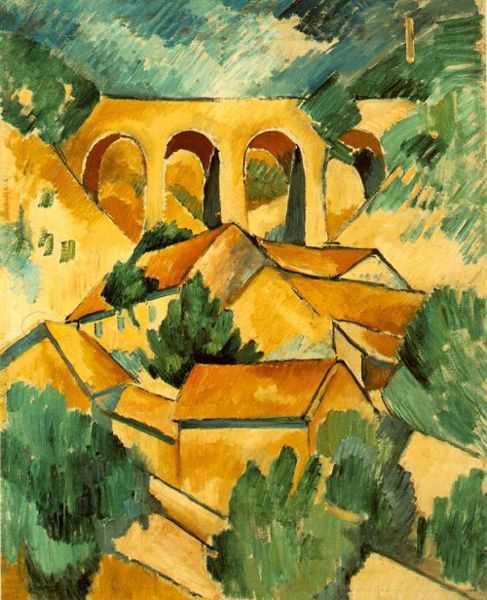
GEORGES BRAQUE (1882-1963)
'Viaduct at L'Estaque', 1908 (oil on canvas)
The Cubists saw the limitations of perspective as an obstacle to progress. The fact that a picture drawn in perspective could only work from one viewpoint restricted their options. As the image was drawn from a fixed position, the result was frozen, like a snapshot, but the Cubists wanted to make pictures that reached beyond the rigid geometry of perspective. They wanted to introduce the idea of 'relativity' - how the artist perceived and selected elements from the subject, fusing both their observations and memories into the one concentrated image. To do this the Cubists examined the way that we see.
When you look at an object your eye scans it, stopping to register on a certain detail before moving on to the next point of interest and so on. You can also change your viewpoint in relation to the object allowing you to look at it from above, below or from the side. Therefore, the Cubists proposed that your sight of an object is the sum of many different views and your memory of an object is not constructed from one angle, as in perspective, but from many angles selected by your sight and movement. Cubist painting, paradoxically abstract in form, was an attempt at a more realistic way of seeing.
A typical Cubist painting depicts real people, places or objects, but not from a fixed viewpoint. Instead it will show you many parts of the subject at one time, viewed from different angles, and reconstructed into a composition of planes, forms and colours. The whole idea of space is reconfigured: the front, back and sides of the subject become interchangeable elements in the design of the work.
The Cubist Artists
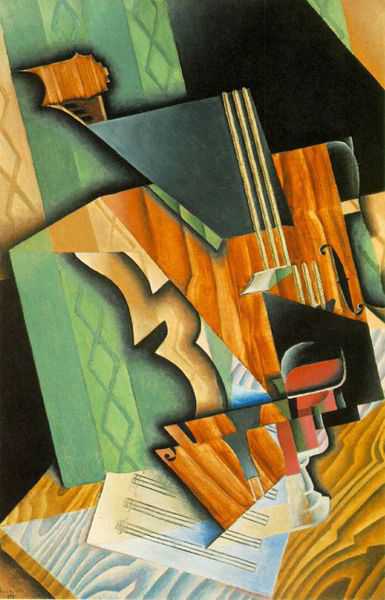
JUAN GRIS (1887-1927)
'Violin and Glass', 1915 (oil on canvas)
Pablo Picasso and Georges Braque conceived and developed Cubism but other artists also adopted the style. The Spanish artist Juan Gris, who is often referred to as the 'Third Musketeer of Cubism', was the best of these and he refined the Cubist vocabulary into his own instantly recognizable visual language. Other notable artists associated with Cubism were Fernand Leger, Robert Delaunay, Albert Gleizes, Jean Metzinger, Louis Marcoussis, Marie Laurencin and Roger de La Fresnaye.
The Influence of African Art
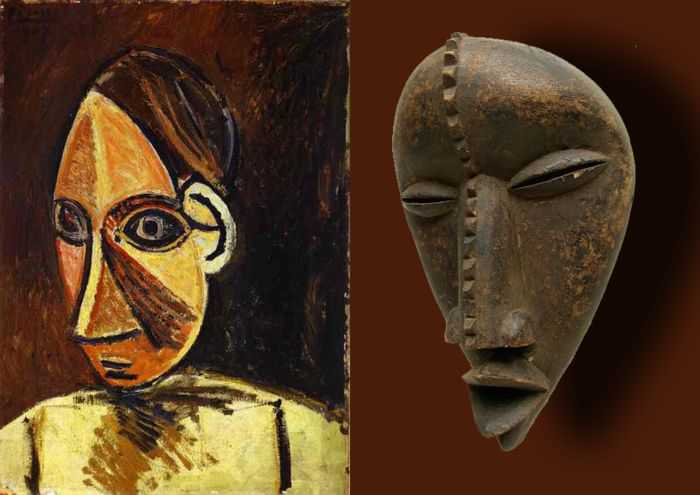
LEFT: Pablo Picasso, 'Head of a Woman', 1907 (oil on canvas)
RIGHT: Dan Mask from West Africa
The Cubists believed that the traditions of Western art had become exhausted and another remedy they applied to revitalize their work was to draw on the expressive energy of art from other cultures, especially African art. However, they were not interested in the true spiritual or social symbolism of these cultural objects, but valued them superficially for their expressive style. They viewed them as subversive elements that could be used to attack and subsequently refresh the tired tradition of Western art. This inspiration to cross-reference art from different cultures probably came from Paul Gauguin, the French post-impressionist artist, whose paintings and prints were influenced by the native culture of Tahiti and the Marquesas Islands where he spent his final years.
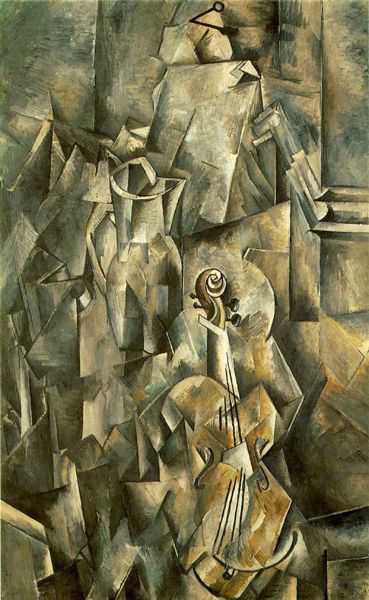
GEORGES BRAQUE (1882-1963)
'Violin and Jug', 1910 (oil on canvas)
Cubism had two distinct phases. The early phase which lasted until about 1912 was called Analytical Cubism. Here the artist analyzed the subject from many different viewpoints and reconstructed it within a geometric framework, the overall effect of which was to create an image that evoked a sense of the subject. These fragmented images were unified by the use of a subdued and limited palette of colours.
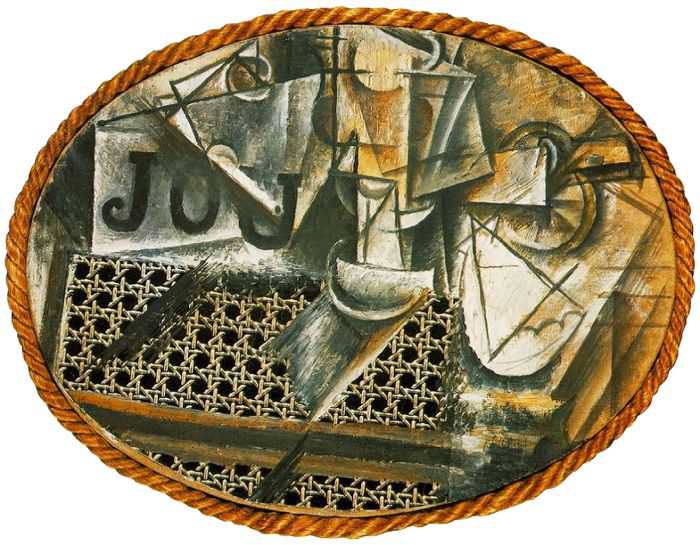
PABLO PICASSO (1881-1973)
'Still Life with Chair Caning', 1912 (oil on canvas)
Around 1912, the styles of Picasso and Braque were becoming predictable. Their images had grown so similar that their paintings of this period are often difficult to tell apart. Their work was increasingly abstract and less recognizable as the subject of their titles. Cubism was running out of creative steam. In an attempt to revitalise the style and pull it back from total abstraction, Picasso began to glue printed images from the 'real world' onto the surface of his still lifes. His painting 'Still Life with Chair Caning’ was the first example of this 'collage' technique and it opened the door for himself and other artists to the second phase of the Cubist style: Synthetic Cubism.
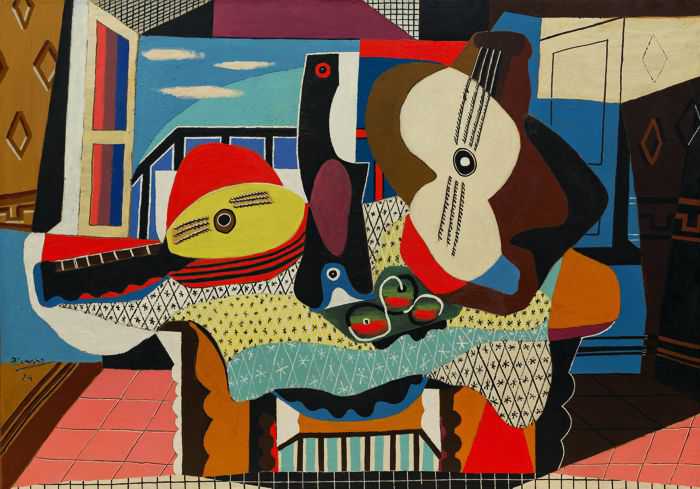
PABLO PICASSO (1881-1973)
'Still Life with mandolin and Guitar', 1924 (oil on canvas)
Influenced by the introduction of bold and simple collage shapes, Synthetic Cubism moved away from the unified monochrome surfaces of Analytic Cubism to a more direct, colorful and decorative style. Although synthetic cubist images appear more abstract in their use of simplified forms, the other elements of their composition are applied quite traditionally. Interchanging lines, colours, patterns and textures that switch from geometric to freehand, dark to light, positive to negative and plain to patterned, advance and recede in rhythms across the picture plain.
Beyond Cubism
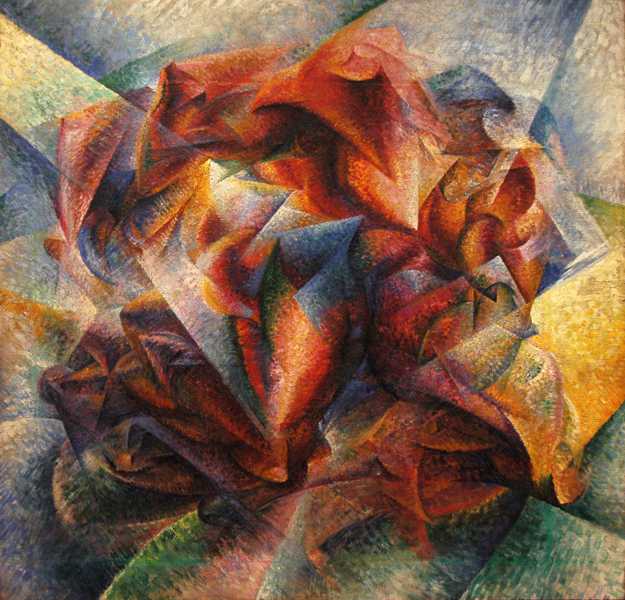
UMBERTO BOCCIONI (1882-1916)
'Dynamism of a Soccer Player', 1913 (oil on canvas)
Cubism was born in France but emigrated across Europe and integrated with the artistic consciousness of several countries. It emerged as Futurism in Italy (illustrated), Vorticism in England, Suprematism and Constructivism in Russia, and Expressionism in Germany. It also influenced several of the major design and architectural styles of the 20th century and prevails to this day as mode of expression in the language of art.
Cubism Notes
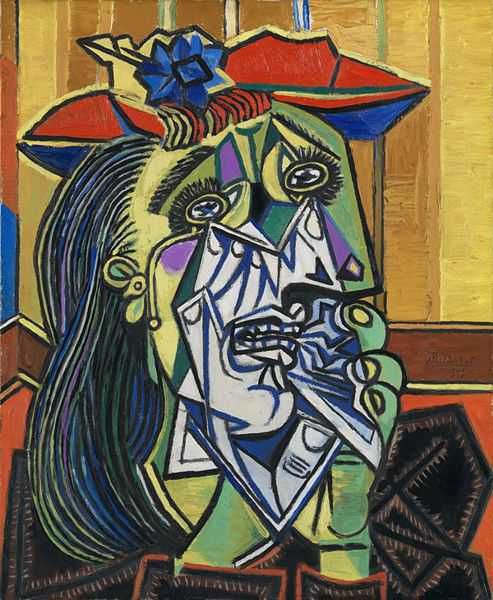
PABLO PICASSO (1881-1973)
'Weeping Woman', 1937 (oil on canvas)
Cubism was invented around 1907 in Paris by Pablo Picasso and Georges Braque.
-
Cubism was the first abstract style of modern art.
-
A Cubist painting ignores the traditions of perspective drawing and shows you many views of a subject at one time.
-
The Cubists introduced collage into painting.
-
The Cubists were influenced by art from other cultures, particularly African masks.
-
There are two distinct phases of the Cubist Style: Analytical Cubism (pre 1912) and Synthetic Cubism (post 1912)
-
Cubism influenced many other styles of modern art including Orphism, Futurism, Vorticism, Suprematism, Constructivism and Expressionism.