Western Art Timeline Part 1 - Byzantine Art to the High Renaissance
Our Western Art Timeline from 330- 1600 gives an outline of the most important artists, movements and styles of painting from Byzantine Art to the High Renaissance.
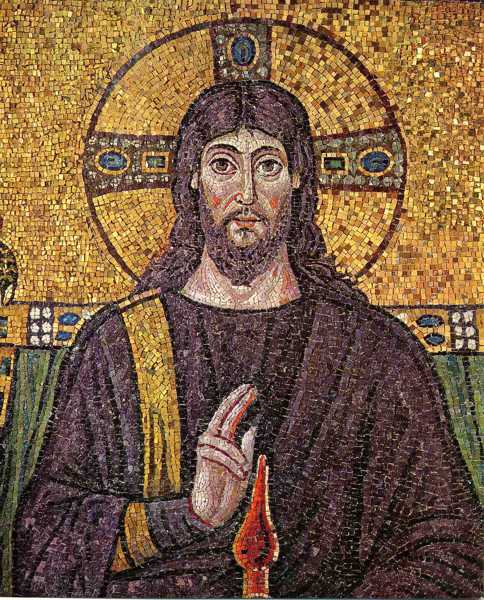
BYZANTINE MOSAIC - Sant'Apollinare Nuovo, Ravenna, Italy
Detail of 'Christ Dressed as a Byzantine Emperor', 6th century
Byzantine Art developed when Constantine the Great relocated the capital of the Roman Empire to the Greek city of Byzantium in AD 330. Byzantium, later known as Constantinople and more recently as Istanbul, was the gateway between Asia and Europe.
As a consequence of its location, Byzantine art evolved as a cultural mix of styles from the east and west. Christianity became the official religion of the Roman Empire after the conversion of Constantine and it was the duty of the Emperor to unite the faith across the empire by bringing the various heretical groups into line and standardizing Christian teaching. Therefore the form of Byzantine art was strictly controlled to eliminate any personalized or unorthodox interpretation of its imagery. Its fixed conventions were a reflection of the unalterable nature of Christian teaching.
The three main forms of Byzantine art were the large scale mosaics used to decorate the walls and interior domes of Byzantine churches, the smaller scale religious icons which were portable panel paintings of Christ and the Blessed Virgin, and the illuminated manuscripts from the Gospels and other religious texts. Byzantine figures were stylized in a frontal and symbolic format, inviting spiritual worship and offering protection to the devout. Due to the depersonalized nature of the art, many of the Byzantine artist remain anonymous but the Russian, Andrei Rublev (c.1360-1430) and Theophanes the Greek (c.1340-1410) are two of the most noteworthy.
The Byzantine empire lasted until the fall of Constantinople to the Ottomans in 1453 and marks the end of the Roman Empire.
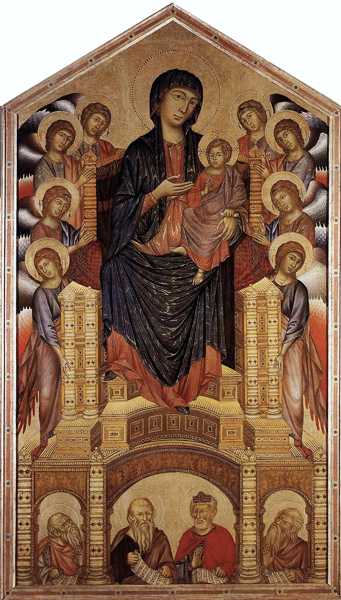
CIMABUE (1240-1302)
'Maestà (Majesty)', c.1280- 85
(tempera on panel)
Gothic Art defines much of the late medieval art that grew out of the Byzantine and Romanesque traditions. These were very formal artistic traditions with rigorous religious conventions that limited the personal creativity of the artist. At this time, the quality of an artwork was judged by the richness of the materials used to create it and the skill with which they were applied.
Gothic art is distinguished from its predecessors by an increasing naturalism in the shape and posture of the figures, and an expressive use of line, pattern and color, allowing the artist more freedom of interpretation. Gothic art started in 13th century Italy and developed throughout Europe until the 15th century. The most influential artists associated with the style are Nicola Pisano (c.1220-1284) and Cimabue (c.1240-1302), both of whom are key figures in the emergence of Western sculpture and painting respectively.
The term ‘Gothic’, originally related to the barbarity of the Gothic tribes (the Ostrogoths and Visigoths) in their destruction of the art of Ancient Rome. It was first coined by 16th century Italian Renaissance critics as a term of abuse for various developments in medieval art and architecture up to the start of the 14th century.
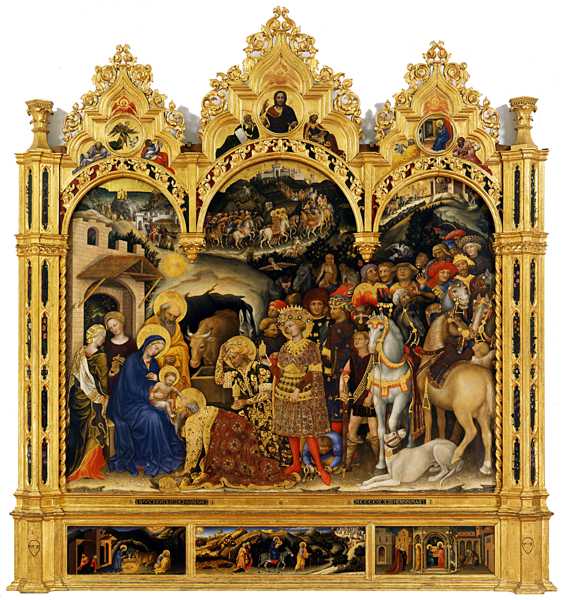
GENTILE DA FABRIANO (c.1370-1427)
'The Adoration of the Magi', 1423 (tempera on panel)
International Gothic is the term used to describe the transition of styles across Northern Europe and Italy during the period between Byzantine Art, Late Gothic Art and Early Renaissance art.
International Gothic was an elegant, detailed and decorative style that comprised miniatures, illuminated manuscripts and ornate religious altarpieces. These artworks were populated by more natural and sensual figures than their Byzantine and Gothic counterparts, but were still composed within the flattened pictorial space common to all Gothic art before the development of perspective drawing in the 15th century.
Some of the leading artists associated with the movement are Simone Martini (1284-1344), Ambrogio Lorenzetti (1290-1348), Gentile da Fabriano (c.1370-1427), Lorenzo Monaco (c.1370-1425), Pisanello (c.1395-1455) and Fra Angelico (c.1400-1450) from Italy, and Melchior Broederlam (1350-1409) and the Limbourg brothers, Herman, Paul, and Johan (c.1385-1416) from the Netherlands.
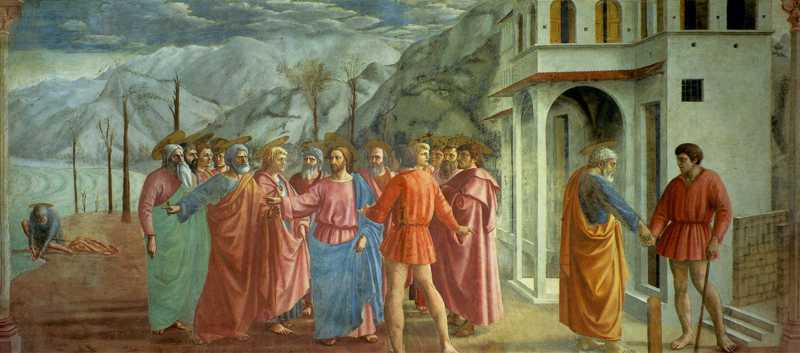
MASACCIO
(c.1401-1428)
'The Tribute Money', 1426
(fresco)
The Early Renaissance was the period of artistic development in Italy when art broke away from the rigid Byzantine and Gothic traditions to develop a more naturalistic approach to drawing and the organization of figures within a landscape. The roots of these changes lay in the more solid rendering of form and the gestural narratives of Giotto's painting. A more precise way of rendering depth was gradually developed through the creative application of perspective drawing in the work of artists such as Masaccio, Uccello, Fra Angelico and Piero della Francesca.
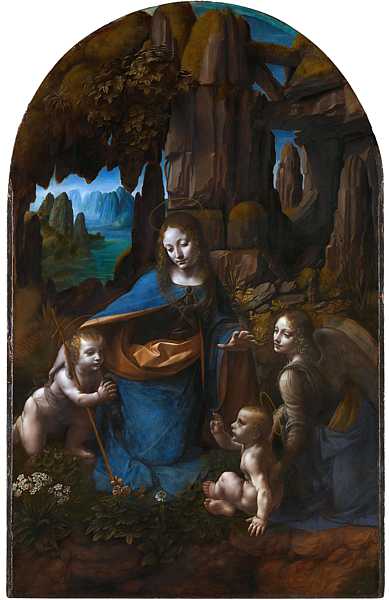
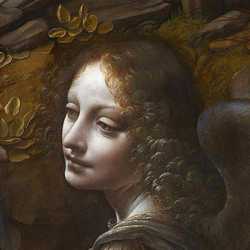
LEONARDO DA VINCI (1452-1519)
'The Madonna of the Rocks', 1483-86
(oil on panel)
The High Renaissance marks the pinnacle of artistic development in Italian art of the late 14th, 15th and early 16th centuries. The word 'Renaissance' means 'rebirth' - a rebirth of the classical ideals from Ancient Rome and Greece.
The great artists of the High Renaissance were Leonardo da Vinci and Michelangelo Buonarroti from Florence, Raphael Sanzio from Umbria, and Titian (Tiziano Vecellio) and Tintoretto (Jacopo Robusti) from Venice. They painted artworks of unprecedented skill and beauty and were responsible for raising the status of the artist in society from the level of artisan to an intellectual plane on a par with writers, philosophers and scientists. These great masters achieved what artists had aspired to since the Early Renaissance: a revival of the classical ideals of beauty and form; an anatomical and scientific accuracy in drawing; a sensual and psychological response to color and composition, and an acceptance and appreciation of classical content as the subject matter for art.
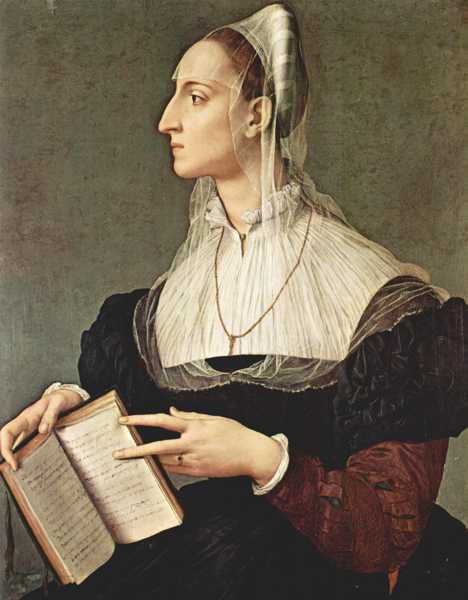
BRONZINO (Agnolo di Cosimo) (1503-1572)
'Portrait of Laura Battiferri', 1555
(oil on canvas)
Mannerism is a 20th century term that was used to describe several exaggerated or mannered styles of art that evolved towards the end of the High Renaissance. Mannerist artists valued a personal and idealized response to beauty over the classical ideal of ‘truth to nature’. The more robust qualities of Mannerism are found in the exaggerated physiques and contorted figures from the late work of Michelangelo, Raphael, Tintoretto and El Greco. A more refined response to the Mannerist style is seen in the elegant and elongated figures from the paintings of Agnolo Bronzino, Parmigianino and Jacopo Pontormo.
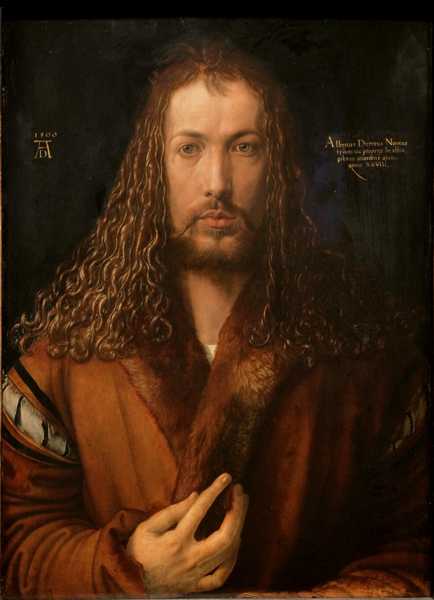
ALBRECHT DÜRER (1471-1528)
'Self Portrait', 1500
(oil on wood panel)
The Northern Renaissance is the term given to the art of north and west Europe during the Italian Renaissance.
In the 15th century, art in the north was still linked to the Gothic tradition but rendered with an exquisite naturalistic detail in the new medium of oil paints. Flanders was the main focus of artistic activity with Flemish artists such as Robert Campin, Rogier van der Weyden, Hugo van der Goes and Jan van Eyck.
In the 16th century the Gothic influence had its final say in the art of Hieronymus Bosch and Matthias Grünewald. Gradually the influence of the Italian Renaissance took hold, particularly in the work of Albrecht Dürer which offered a Protestant challenge to the authority of the Catholic Church.